
The Problem
I kept finding out about great Atlanta stuff after it happened. Eventbrite could give me 500 events, but it couldn’t answer the question I actually had: I want to see Dave — what are six things we’d both like, and which three nights am I free?
I wanted more music, dancing, outdoor adventures, and family activities. With two small kids, calendars did most of the deciding. The hard part was turning “we should hang out” into a plan someone could say yes to.
What It Is
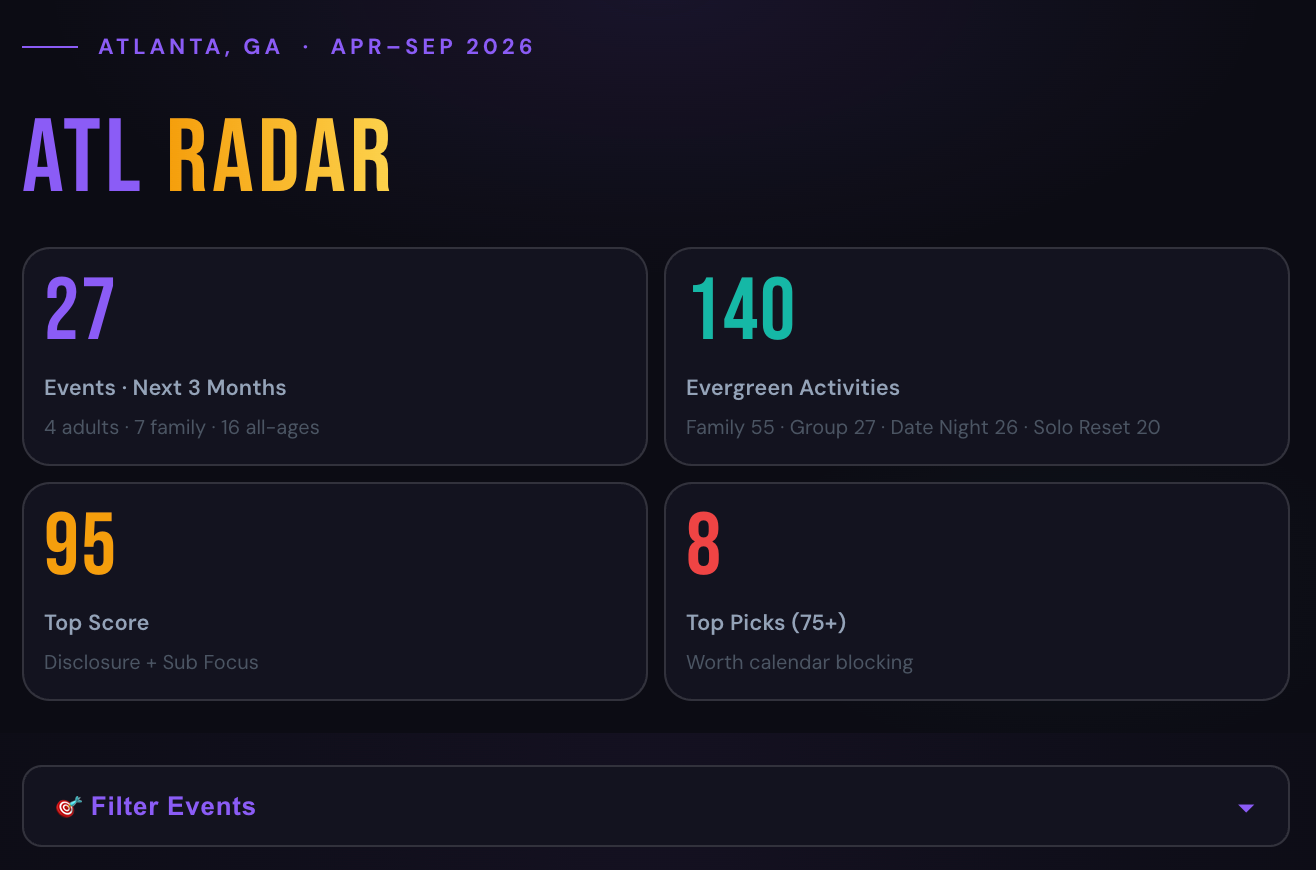
Radar scrapes the city wide, then ranks everything against a taste profile built from years of my concert history and Spotify data — each event scored 0–100 by an LLM across five axes: genre match, venue quality, format rarity, lineup strength, value for money. Radar charts show why each event received its score. A wizard walks through a few preference questions and re-ranks everything live.
The feed updates continuously; alongside dated events, a deep bench of evergreen activities (free hikes, pools, family spots) covers the “what do we do today” case.
The Part That Matters: The Invite
Finding the right event is one half of the job. The other is turning it into a plan: pick a handful of events plus a few free evenings, and send one link or a plain-text invite a friend can answer with a yes or a maybe in a single text. Proposed times and evergreen fallbacks reduce the back-and-forth that usually kills a plan.
When It Became Real
By July, I was no longer only demoing Radar. I was using it in the part of life it was built for: reconnecting with people.
In one conversation, a friend and I moved from talking generally about getting together to a short invitation with a Shakespeare performance, a storytelling night, live music, and a specific afternoon for coffee. In coaching, I caught myself describing the site as something I had been using to make plans and connections. That mattered more than merely having built it.
The outcome I care about is a plan that leaves the group chat.
How I Use It
- Weekend scan — Friday morning, see what’s good in the next 2–3 days
- Spontaneous Sunday — browse evergreen activities for impromptu outings
- Date night — filter for “Dima + Jeannie, no kids”
- Family outing — age-gated activities filtered for a 4-year-old
- Reconnection — a weekly script pairs overdue friends with upcoming events as a concrete excuse to reach out
What Is Still Uncertain
- Whether people besides me find the ranking meaningfully better than a normal calendar
- Which sources and neighborhoods the scraper still misses
- Whether an invitation link gets a faster answer than a thoughtful text
- How much calendar context can be useful without making the tool invasive
Those are usage questions, not feature requests. The next version should come from watching people plan.