The Problem
I had two toddlers, a new VP job, and about six hours to figure out which AI businesses I might actually want to build — given my actual constraints, edges, and available time. How do you think through AI opportunities at scale without getting trapped in hype or execution fantasyland?
The Experiment
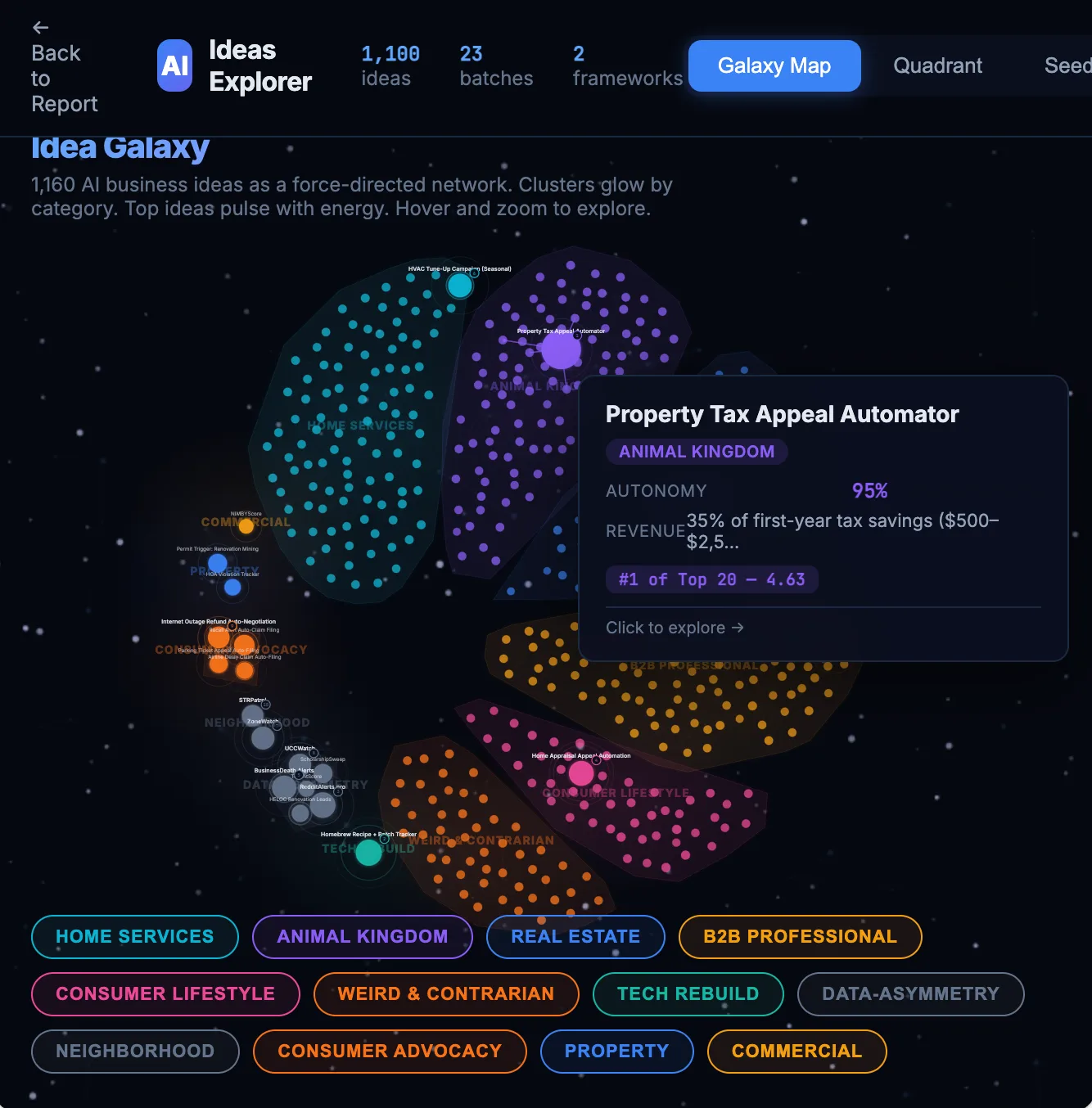
I split the question across dozens of Claude agents running in parallel, each given a single industry vertical and instructions to generate ideas across a spectrum from “obvious and safe” to “weird and ambitious.” The run produced 1,160 ideas in about 6 hours.
To be precise about what this is: the ideas were generated and scored by models — a structured way to explore a huge space fast. None of them carry external market validation; the scoring is my judgment encoded into a formula, applied consistently at scale.
What I Actually Learned
The scoring framework went through 4 rounds of recalibration — I kept changing the weights whenever the results felt wrong, which was the actual work. Nine dimensions: Autonomy, Revenue, Market, Speed, Buildability, Defensibility, Execution, Experience, Geography.
The biggest insight: autonomy matters more than revenue. When I deprioritized revenue-per-customer (from 20% to 12% of the formula), “boring autonomous” ideas — HVAC seasonal campaigns, internet outage refund bots, permit scrapers — surged past high-revenue plays that needed humans in the loop.
The top-scoring idea was a Property Tax Appeal Automator. It runs on public county data, triggers deterministically, and compounds via a proprietary outcome database. Not sexy. Just correct.
What It Turned Into
The more interesting version appeared during a live brainstorm with a friend. While we talked, five small research agents investigated five ideas in parallel. Their findings flowed into a shared board with sources, competing products, warnings, and a one-line verdict.
He did not have to become a prompt engineer or wait for a follow-up deck. He could watch a fuzzy possibility become concrete, challenge what came back, and decide where we should dig next.
That was the lightbulb for me: the superpower is not having more agents. It is helping another person see what is now possible, then giving them a way to shape the work with you.
The board still did not validate the businesses. It made the next conversation much better.
Live
Explore all 1,160 ideas at ai-ideas-explorer.vercel.app.
 Claude